



ArchivesLeading Below the Surface

Ep 62: Breaking Dominant Leadership Standards: From Big Tech to Conscious Living with Executive Coach Kvon Tucker

In this candid episode of Leading Below the Surface, I sit down with executive coach and Consciously CEO Kvon Tucker to talk about what it really takes to break away from dominant leadership standards – especially inside big-name companies like Netflix, Amazon, and Google.

Episode Summary

Kvon shares how a suicidal depression in his late 20s became a turning point, why he ultimately walked away from a “dream” tech career, and how he and his family ended up in Costa Rica designing a more human, spiritually aligned life. We unpack the dangerous mix of hypergrowth, fear-based leadership, and ego-driven cultures – and what it looks like to lead consciously instead, in a way that centers love, liberation, and human wellbeing.

This is a below-the-surface conversation about work, worth, ego, redemption, and the kind of leadership our world actually needs right now.


Episode Highlights

In this conversation, we explore:

  • How Kvon’s mental health crisis woke him up to a life and career he didn’t actually choose.
  • His path through Netflix, Amazon, and Google – and what was really happening beneath the “best places to work” branding.
  • The “dark triad” traits that often get rewarded in dominant leadership cultures, and why they’re so harmful.
  • Hypergrowth vs. natural growth: why the pace that works for business often breaks human bodies.
  • What it looks like to leave a prestigious corporate job to become a full-time dad, coach, and founder in Costa Rica.
  • How Kvon now thinks about ego, love, boundaries, and redemption.
  • Three practices he recommends for anyone who wants to lead more consciously: meditation, healing work (like therapy), and coaching.

Key Insights

  • Dominant leadership standards are often built on fear, hypergrowth, and ego – not love, wellness, or liberation.
  • Big-name “dream companies” can simultaneously offer incredible opportunities and deeply misaligned cultures. Both can be true.
  • Hypergrowth works for revenue, but it’s usually unsustainable for human nervous systems and family life.
  • Many leaders are waking up to the fact that the path they’ve been on is no longer serving them – there’s a real shift in collective consciousness happening.
  • Ego isn’t always “bad.” It can be redirected toward growth and impact when we’re aware of it and in relationship with it.
  • Love, for Kvon, looks like asking: “What is the most loving action for my own spiritual growth and for the other person?” Sometimes that means closeness; sometimes it means distance and boundaries.
  • You can’t be serious about liberation if you’re not serious about practices that help you know yourself – like meditation, therapy, and coaching.

ABOUT OUR GUEST – KVON TUCKER

Kvon Tucker is an executive coach and the CEO of Consciously, a coaching and consulting company that helps leaders build more conscious, human-centered organizations. Before founding Consciously, he led manager and leadership development at companies including Netflix, Amazon, and Google. Today, Kvon coaches leaders around the world as they navigate identity shifts, burnout, and the desire to lead in a way that’s more aligned with their values, spiritual growth, and real life. He lives in Costa Rica with his wife and daughter.

Learn more about Kvon:


Connect with us:

Email us at ⁠info@changecoaches.io⁠

Learn more about Change Coaches⁠

Follow LaTonya on ⁠LinkedIn⁠

Follow Change Coaches on ⁠LinkedIn⁠

For More on the Book Leading Below the Surface


Podcast Summary Transcript:

Note: These are approximate, based on transcript — not pulled directly from the audio)

[00:00] Welcome & why this conversation matters

  • LaTonya introduces the episode, naming dominant leadership standards and why they’re so present in organizations right now.

  • She shares how she met Kvon in a BIPOC coaching space and why his work at Consciously felt different from the start.

[03:30] Kvon’s turning point: suicidal depression and a life he didn’t choose

  • Kvon describes hitting a suicidal depression in his late 20s and realizing he was living a life others had scripted for him.

  • Therapy became a lifeline and opened the question: “Who is Kvon and what life do I want?”

[08:00] Discovering coaching and the path into Big Tech

  • A mentor “prescribed” coaching training after watching him facilitate, and Kvon walked out of his first course knowing this was his life’s work.

  • Sharing his perspectives on LinkedIn led to roles in manager and leadership development at Netflix, Amazon, and Google.

[13:00] Inside the “dream companies” – and the dark triad

  • Kvon talks about arriving at Netflix and quickly realizing “this place is crazy” beneath the glossy brand.

  • He names the dark triad traits (narcissism, psychopathy, and duplicitousness) that often get rewarded and how they show up in corporate politics.

[18:30] Hypergrowth, fear, and the cost to human bodies

  • At Amazon, Kvon saw firsthand how a culture built on speed and hypergrowth can chew people up and burn them out.

  • He contrasts “good for business” metrics with what chronic pressure and speed do to people’s health and relationships.

[24:00] Google, “finding the right kind of crazy,” and what still didn’t fit

  • Google felt “cushier” and more aligned, but under the surface it was still large tech with fear-driven leadership and growth-at-all-costs.

  • Kvon realized the senior leaders’ priorities (profit, survival, reputation) didn’t match his own values of love, wellness, and liberation.

[29:30] Fatherhood, Costa Rica, and redefining success

  • Becoming a father made Kvon confront a promise: he would not be a full-time employee and full-time dad at the same time.

  • He built up his coaching practice, left Google on his daughter’s first birthday, and moved his family to Costa Rica to live more intentionally.

[35:00] The shift in consciousness among leaders

  • Both LaTonya and Kvon are seeing more executives say, “Everything I believed about leadership… I’m not sure anymore.”

  • Leaders are wrestling with gratitude for opportunity and a growing awareness that the culture and pace are misaligned with who they want to be.

[40:00] Ego, echo chambers, and space for redemption

  • They unpack ego: how Kvon now sees it as a part of us that can be directed toward good rather than shamed or suppressed.

  • LaTonya raises questions about cancel culture, redemption, and whether we leave room for people to evolve as their consciousness shifts.

[46:00] Love as a leadership practice

  • For Kvon, love means extending yourself for the spiritual growth of yourself and others.

  • He asks in each hard situation: “What’s the most loving way to show up for me and for them?” Sometimes that looks like presence; sometimes it looks like distance and boundaries.

[51:00] Practical ways to lead more consciously

  • Kvon shares three core practices: meditation, healing work (like psychotherapy), and coaching as the “creation” layer on top.

  • LaTonya adds her own practices (energy work, movement, rest, and nature) and reflects on how they’ve both built lives that actually match their values.

[56:00] Where to find Kvon and closing thoughts

  • Kvon shares where listeners can find him and Consciously.

LaTonya closes by naming this as a collective turning point in how we understand work, growth, and leadership – and invites listeners to reflect on their own next chapter.
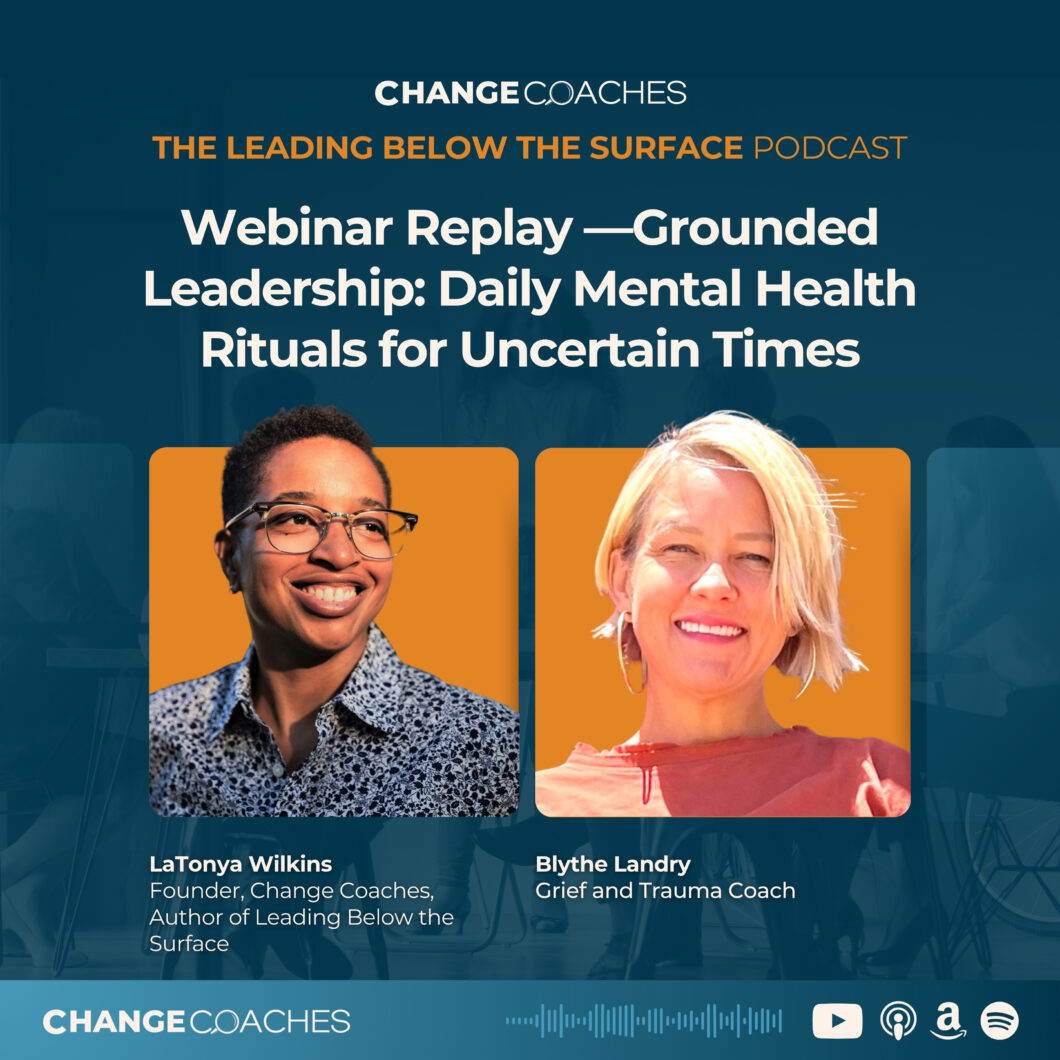
Ep 61: Webinar Replay — Grounded Leadership: Daily Mental Health Rituals for Uncertain Times

Replay of a Change Coaches Community Event with Blythe Landry

Episode Summary

In this special replay of a Change Coaches Community Event, we explore how to stay mentally, emotionally, and physiologically grounded while leading in uncertain times. Blythe Landry — therapist, trauma specialist, and author of Trauma Intelligence — joins LaTonya to share real-world, accessible mental health practices that help leaders thrive without burning out. You’ll hear discussion, guidance, and tools rooted in science, nervous-system awareness, grief work, and Below the Surface leadership. We also uplift wisdom from the community members who joined live — demonstrating the power of connection and shared learning. This isn’t self-care theory. It’s practical, lived resilience for today’s world.

Key Insights

  • Leaders can’t control chaos — but they can control rituals, structure, and presence
  • Nervous system literacy is leadership literacy
  • Recovery isn’t indulgent — it’s strategic
  • Community care is a resilience multiplier
  • Connection beats isolation — every time

Episode Highlights

  • Why uncertainty fuels stress — and how leaders can respond with grounding, not urgency
  • The role of micro-rest, boundaries, and intentional recovery
  • Tools to reconnect with your body and calm your nervous system
  • Emotional hygiene habits and rituals to keep you steady
  • How to support others without carrying their emotional load
  • The restorative power of nature, community, and mindful movement
  • What it looks like to lead like a human — not a machine

About Today’s Guest: Blythe Landry

Blythe Landry, MSW, MEd, LCSW, is a nationally recognized trauma and grief therapist, author of Trauma Intelligence, and founder of Grief to Purpose, a program supporting individuals healing from loss. She brings 25 years of experience helping people transform grief and adversity into grounded strength and connection. Learn more about Blythe at BlytheLandry.com

Call to Action

If today’s conversation resonated, share it with someone who leads with heart and is navigating uncertainty.

To deepen your practice and connect live with other values-driven leaders, join our community events list — we’d love to see you in the room next time.


Connect with us:

Email us at ⁠info@changecoaches.io⁠

Learn more about Change Coaches⁠

Follow LaTonya on ⁠LinkedIn⁠

Follow Change Coaches on ⁠LinkedIn⁠

For More on the Book Leading Below the Surface


Podcast Summary Transcript:

Note: These are approximate, based on transcript — not pulled directly from the audio)

[00:00] Welcome and why this topic matters

  • Mental health as leadership skill
  • Why “resetting” is a modern leadership reality

[03:17] Meet Blythe Landry

  • Therapist, grief expert, trauma specialist
  • Helping people transform pain into purpose

[06:42] Community check-in & poll results

  • How leaders are really feeling right now
  • Common barriers to caring for mental health

[10:28] Micro-rest & reset rituals

  • Small practices that create big grounding
  • Healthy media hygiene & rest as resistance

[15:45] Discipline vs. urgency

  • Why structure builds emotional freedom
  • Routines that sustain nervous system health

[20:14] Somatics & the body’s wisdom

  • Noticing sensations instead of reacting
  • Mini-regulation tools you can use anywhere

[26:38] Boundaries & burnout protection

  • Slowing down to prevent emotional fatigue
  • Name it to navigate it

[30:54] Reflection from the community

  • Hiking, journaling, therapy, breath work
  • The power of connection & shared humanity

[35:20] Closing wisdom

  • What grounding looks like in real life
  • “We don’t worry alone here.”

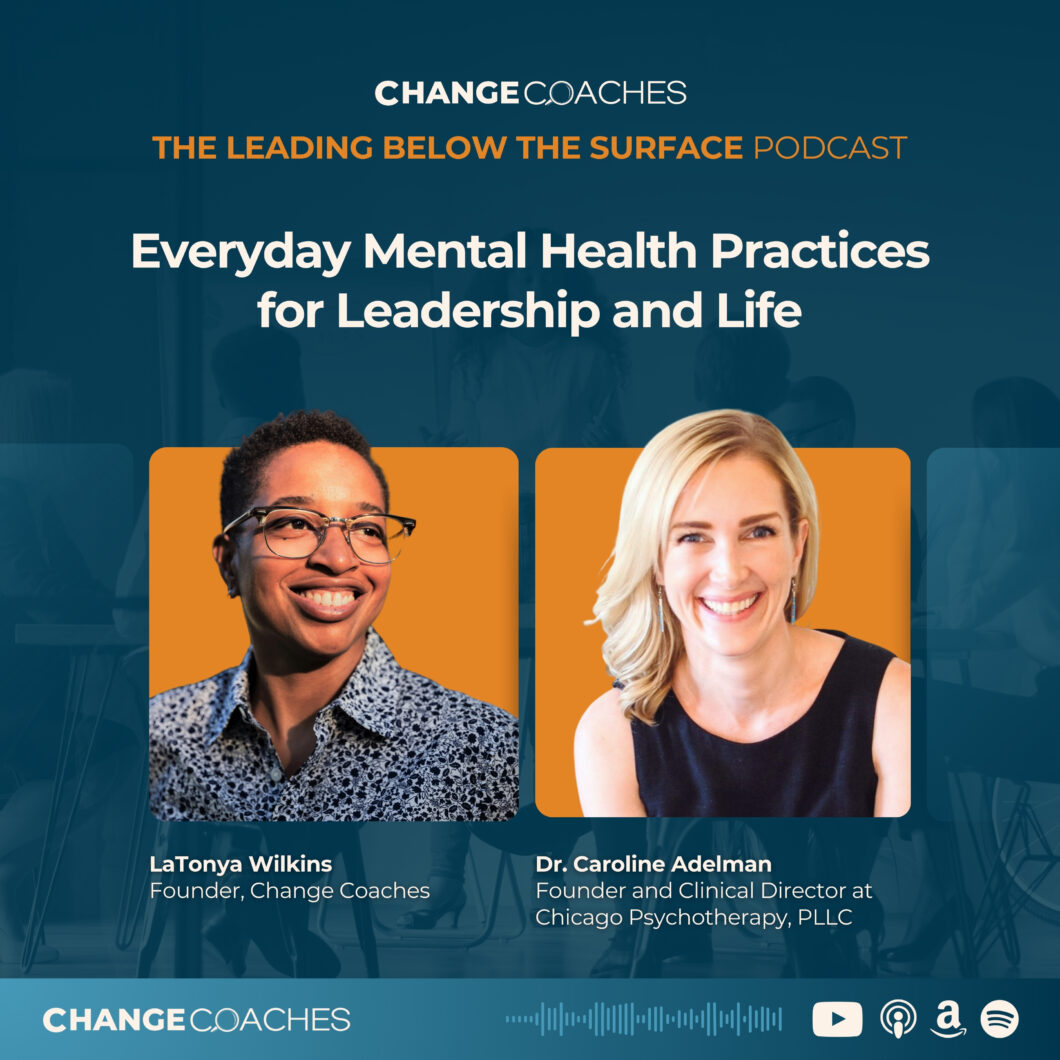
Ep 60: Everyday Mental Health Practices for Leadership and Life (with Dr. Caroline Adelman)

In a world that increasingly feels uncertain — and at times, broken — how do we stay grounded as leaders and human beings?

Episode Summary

In this powerful conversation, LaTonya Wilkins sits down with Dr. Caroline Adelman, clinical psychologist, coach, and founder of Chicago Psychotherapy, to explore what it truly means to lead and live well amid chaos. Together, they uncover how chronic stress, disconnection, and unpredictability shape our lives — and how we can rebuild connection through everyday mental health practices that actually work.

Dr. Adelman shares evidence-based techniques rooted in therapy and neuroscience that help leaders regulate emotions, create stability, and bring real compassion into the workplace. Whether you’re leading a team, a business, or just trying to stay grounded yourself, this conversation offers practical wisdom for navigating a complex, broken world — one human moment at a time.


Key Insights

  • Connection — not control — is the foundation of resilience.
  • Stress disconnects us from ourselves, others, and what matters most; awareness and intention reconnect us.
  • Leaders don’t need to have all the answers, but they do need to show care, humility, and hope.
  • Simple rituals — listening, check-ins, walk-and-talks — can transform workplace wellbeing.
  • Human-centered leadership is the antidote to fear-based systems.

Guest Bio — Dr. Caroline Adelman

Dr. Caroline Adelman, PhD, is a clinical psychologist, coach, and founder of Chicago Psychotherapy. She completed her PhD at the University of North Carolina at Chapel Hill and fellowships at the Yale Child Study Center. She previously served on the clinical faculty at Northwestern University and has spent over fifteen years helping children, adults, and professionals navigate anxiety, trauma, and transitions.

Dr. Adelman’s work integrates evidence-based therapy with compassion, humor, and authenticity. She’s a frequent speaker and consultant on resilience, wellness, and leadership.

To learn more, visit ChicagoPsychotherapy.com/dr-caroline-adelman.


Resources Mentioned


Connect with us:

Email us at ⁠info@changecoaches.io⁠

Learn more about Change Coaches⁠

Follow LaTonya on ⁠LinkedIn⁠

Follow Change Coaches on ⁠LinkedIn⁠

For More on the Book Leading Below the Surface


Podcast Summary Transcript:

Note: These are approximate, based on transcript — not pulled directly from the audio)

[00:00] Introduction — Welcoming Dr. Caroline Adelman and setting the stage for a deep conversation on mental health and leadership.

[03:20] The role of intergenerational stories and resilience.

[07:45] Connection as the antidote to stress and disconnection.

[14:10] Understanding how chronic stress hijacks our brains — and what leaders can do about it.

[20:00] What followers need most from leaders in uncertain times: trust, compassion, stability, and hope.

[28:40] How to ground teams when the world feels chaotic.

[36:15] Practical, evidence-based mental health practices for leaders and teams.

[45:30] When to know someone might need therapy — and how leaders can respond with empathy.

[53:00] Final reflections: why we can’t do this alone and how to model human-centered leadership.

Ep 59: The Dominant Leadership Standards: Why They are Failing Us

Authoritarian, fear-based leadership might seem loud and everywhere—but that doesn’t mean it’s working. In this solo episode, LaTonya Wilkins, award-winning executive coach and author of Leading Below the Surface (second edition out Sept. 24), unpacks why dominant leadership standards—rigidity, perfectionism, and toxic meritocracy—are failing organizations today. Drawing on Chapter 2 of her book, LaTonya contrasts authoritarian and relational leadership, shares personal insights from the field, and explains why relational leadership is the future in an era of mental health challenges, AI disruption, and broken systems.

Episode Summary

She also teases upcoming guest conversations on mental health and conscious leadership. If you’ve been told to “toughen up” or “lead with fear” to get results, this episode will give you evidence, strategies, and courage to lead differently.


Key Insights

  • Dominant leadership standards (rigidity, fear, optics) are outdated and erode innovation and psychological safety.
  • Authoritarian leadership thrives on fear and appears louder than it is—but relational leadership creates sustainable performance.
  • Relational leadership is essential as workplaces face unprecedented challenges and employees bring their whole selves to work.
  • Situational leadership and coaching cultures are powerful relational tools that drive inclusion, collaboration, and trust.
  • Sticking with relational leadership—even when pressured to adopt authoritarian tactics—pays off in alignment, creativity, and resilience.

Calls to Action

  • Subscribe/Follow: Apple Podcasts, Spotify, and Change Coaches YouTube Channel to catch every episode.
  • Leave a Review or Share: If this episode resonated, leave a review on Apple Podcasts or Spotify, and share it with a colleague or friend.
  • Explore More: Visit LeadingBelowTheSurface.com and ChangeCoaches.io for book updates, keynotes, workshops, and coaching.
  • Book Talks: Want a Leading Below the Surface book talk for your team? Email info@changecoaches.io to schedule—limited slots each month.
  • Connect with LaTonya: LinkedIn — share your thoughts or let her know how relational leadership is showing up in your world.
  • Next Episode Preview: Don’t miss next week’s conversation on Everyday Mental Health Practices for Leadership and Life—practical ways leaders can support wellness in a world that feels broken.

Resources & Links


Connect with us:

Email us at ⁠info@changecoaches.io⁠

Learn more about Change Coaches⁠

Follow LaTonya on ⁠LinkedIn⁠

Follow Change Coaches on ⁠LinkedIn⁠

For More on the Book Leading Below the Surface


Podcast Summary Transcript:

Note: These are approximate, based on transcript — not pulled directly from the audio)

[00:00] Welcome + second edition book update

[02:15] Why revisit dominant leadership standards now

[05:10] Different types of leadership (authoritarian, relational, servant, situational)

[10:20] Authoritarianism’s rise & why fear-based control fails long term

[14:50] Chapter 2 insights: The Dominant Leadership Standard explained

[19:30] Returns on relational leadership—alignment, innovation, and trust

[24:40] Situational leadership & coaching cultures as relational tools

[28:15] How to stick with relational leadership when pressured to conform

[32:00] Closing thoughts + teaser for next episode on mental health practices

Ep 58: 10 Ways Your Organization Will Benefit from Leading Below the Surface

In today’s fast-changing world, surface-level leadership won’t cut it anymore. In this solo episode, LaTonya Wilkins (award-winning executive coach and bestselling author of Leading Below the Surface) walks you through 10 concrete ways organizations benefit when they embrace Below the Surface Leadership.


Episode Summary

From stronger leadership alignment and inclusive decision-making to navigating bias, building real belonging, and creating a shared language for change—even in the age of AI—you’ll hear practical ways to shift culture and performance.

LaTonya also shares an update on the Second Edition of Leading Below the Surface (out this fall!) and how you can bring these practices into your teams and organizations.


What You’ll Learn in This Episode

  • 10 tangible benefits of Below the Surface Leadership
  • Practical ways to apply P2B (Person-to-Belonging) listening
  • Why authenticity and psychological safety are more than trends
  • How to build a shared language for change in uncertain times

10 Benefits of Below the Surface Leadership:

  1. Stronger leadership alignment — deeper communication, shared clarity, and purpose.
  2. Practical, easy-to-use framework — REAL leadership (Relatable, Equitable, Aware, Loyal).
  3. More inclusive decision-making — P2B listening to invite and build on all voices.
  4. Psychological safety becomes the norm — embedded in culture, not a passing trend.
  5. Better team dynamics — empathy + safety + REAL leadership = undefeated.
  6. Bias awareness — recognizing and addressing affinity, confirmation, and group bias.
  7. Authentic leadership — navigating a surface (or broken) world without losing yourself.
  8. Tools to navigate surface culture — practical ways to resist superficiality.
  9. Clarity on belonging — distinguishing real belonging from performative inclusion.
  10. Shared language for change — human-centered leadership in an AI-driven era.

Resources & Links


Connect with us:

Email us at ⁠info@changecoaches.io⁠

Learn more about Change Coaches⁠

Follow LaTonya on ⁠LinkedIn⁠

Follow Change Coaches on ⁠LinkedIn⁠

For More on the Book Leading Below the Surface


Podcast Summary Transcript: 

Note: These are approximate, based on transcript — not pulled directly from the audio)

  • 00:00 — Welcome & intro
  • 01:30 — Book update: Second Edition coming September
  • 03:30 — Why this episode: origin of Below the Surface Leadership
  • 06:00 — #1 Stronger leadership alignment
  • 08:00 — #2 REAL framework as daily practice
  • 10:00 — #3 Inclusive decision-making & P2B listening
  • 12:30 — #4 Psychological safety as a norm
  • 15:00 — #5 Better team dynamics
  • 16:30 — #6 Bias awareness & the “terrible three”
  • 19:00 — #7 Authentic leadership in a surface world
  • 21:30 — #8 Navigating surface culture
  • 22:30 — #9 Real belonging
  • 24:00 — #10 Shared language for change (AI & uncertainty)
  • 27:00 — Recap + call to action

Ep 57: Is Psychological Safety Enough? Rethinking How We Lead and Work

Psychological safety has become one of the most popular leadership buzzwords in recent years. But is it enough on its own?


Episode Summary

Inspired by Amy Edmondson’s recent Harvard Business Review article, executive coach and author LaTonya Wilkins explores the six most common misconceptions about psychological safety — and what leaders can do to move beyond them.

LaTonya also shares exciting news about the second edition of her award-winning book Leading Below the Surface, coming this fall, and gives three practical tips for keeping psychological safety alive in your organization.


What You’ll Learn in This Episode

  • Why psychological safety isn’t about being “nice” or avoiding accountability
  • The difference between safety and job security
  • How safety drives performance and collaboration, not the opposite
  • Why everyone — not just senior leaders — can create safety
  • Three practical ways to make psychological safety last

Connect with us:

Email us at ⁠info@changecoaches.io⁠

Learn more about Change Coaches⁠

Follow LaTonya on ⁠LinkedIn⁠

Follow Change Coaches on ⁠LinkedIn⁠

For More on the Book Leading Below the Surface


Podcast Summary Transcript: 

Note: These are approximate, based on transcript — not pulled directly from the audio)

  • 00:00 – Introduction & announcements (book news + podcast schedule)
  • 04:00 – Why psychological safety matters now more than ever
  • 06:30 – Misconception #1: Psychological safety = being nice
  • 12:30 – Misconception #2: Psychological safety = getting your way
  • 16:00 – Misconception #3: Psychological safety = job security
  • 19:30 – Misconception #4: Safety requires a trade-off with performance
  • 22:30 – Misconception #5: Safety is just a policy
  • 24:30 – Misconception #6: Safety requires a top-down approach
  • 28:30 – Three tips to keep psychological safety alive
  • 34:00 – Closing & what’s next on the podcast

Ep 56: Selling Yourself Without Selling Out: Navigating the Tension Between Self-Promotion and Staying Grounded

In this episode of Leading Below the Surface, LaTonya Wilkins sits down with sales strategist Kelly Hoppesch to unpack the art of selling yourself without feeling fake, pushy, or “salesy.” Whether you’re a CEO, a coach, or simply navigating your career, sales is a skill we all need, even if we don’t think of ourselves as salespeople.


Episode Summary

Kelly shares her insights on empathy in sales, how to build authentic influence, and why selling is really about connection and clarity, not scripts and pressure. You’ll walk away with actionable ways to position yourself, your ideas, and your value; all in a way that feels natural and aligned.


Guest Bio

Kelly Hoppesch is a seasoned sales strategist, specializing in the HR Tech space. She’s held revenue leadership roles at powerhouse brands like LinkedIn, CareerBuilder, and Glassdoor, but her true passion lies in the messy, high-stakes world of startups. In 2021, she founded KH LLC, a consulting firm built to help tech founders unlock revenue and scale smarter, faster, and with purpose.
Kelly believes revenue problems aren’t just about numbers — they’re rooted in people, operations, and execution. Through her work, she helps founders uncover the real heartbeat of their business, rewiring what’s broken so they can move forward with clarity and confidence.


Connect with us:

Email us at ⁠info@changecoaches.io⁠

Learn more about Change Coaches⁠

Follow LaTonya on ⁠LinkedIn⁠

Follow Change Coaches on ⁠LinkedIn⁠

For More on the Book Leading Below the Surface


Podcast Summary Transcript: 

(Times are approximate and based on topic flow — not exact transcript markers)

00:00 – Introduction and welcome

  • LaTonya introduces the theme of selling without selling out

  • Why this topic matters for everyone, not just sales pros

03:00 – Kelly’s background and passion for sales

  • From corporate sales leadership to startup consulting

  • What she’s learned about revenue from different environments

07:15 – Why empathy is the secret sales advantage

  • How empathy changes the conversation

  • Why pushy sales approaches fail in the long run

12:00 – Selling yourself without being “salesy”

  • Reframing sales as connection and problem-solving

  • Identifying your unique value without overselling

18:30 – Common mistakes people make in self-promotion

  • The trap of overexplaining or underselling

  • How to strike the right balance

23:15 – Practical strategies for selling in any role

  • Techniques you can use even if “sales” isn’t in your title

  • Building confidence and clarity in your pitch

28:00 – Closing thoughts and takeaways

  • Kelly’s advice for anyone struggling to put themselves out there

  • How to practice selling in a way that feels authentic

Ep 55: How to Really Listen — and Why It Matters in Leadership, Life, and Everyday Connection

Listening is a skill we all think we’ve mastered—but few of us truly practice it. In this episode of Leading Below the Surface, award-winning executive coach LaTonya Wilkins explores what it takes to listen in today’s high-pressure, fear-filled work environments.


Episode Summary

Through a powerful coaching story and frameworks from her book, LaTonya shares how leaders can move from surface-level interactions to transformational connection using P2P (Person-to-Person) and P2B (Person-to-Belonging) listening.
You’ll walk away with clear, practical tactics for becoming a better listener, handling difficult moments, and building trust—even when times are uncertain.


Key Topics Covered

  • The surprising link between fear and poor listening
  • How empathy has shifted in today’s workplace
  • P2P and P2B listening: what they are and when to use them
  • Body awareness and emotional regulation during conversations’
  • The power of patience and “meandering in the muck”
  • A practical journal prompt to improve your listening habits

🎧 Ready to go deeper? Learn more about our ICF-accredited program: https://changecoaches.worksite.website/coaching-below-the-surface/


Connect with us:

Email us at ⁠info@changecoaches.io⁠

Learn more about Change Coaches⁠

Follow LaTonya on ⁠LinkedIn⁠

Follow Change Coaches on ⁠LinkedIn⁠

For More on the Book Leading Below the Surface


Podcast Summary Transcript: 

[00:00] Introduction and welcome back

  • LaTonya returns after a brief hiatus and introduces the theme: why listening matters now more than ever


  • Reflects on the current rise in fear and anxiety in the workplace


[02:40] Why listening is harder right now

  • Empathy has declined, and fear is creating reactive, defensive environments


  • Many leaders are struggling to listen due to overwhelming noise and uncertainty


[04:50] Coaching story: Navigating fear in an executive team

  • LaTonya shares a story of a leadership team that seemed defensive—but was actually afraid


  • Instead of pushing, she chose to “meander in the muck” and listen more deeply


[09:10] Rethinking “active listening”

  • Active listening is helpful but basic; today’s environment calls for deeper methods


  • Listening is more than ears—it includes body language, intuition, and presence


[11:45] Person-to-Person (P2P) Listening

  • Involves full presence, multiple senses, and deep attention


  • Best used in 1:1s or small groups for authentic human connection


[13:10] Person-to-Belonging (P2B) Listening

  • Observes the collective dynamic in a group setting


  • Powerful for identifying unspoken patterns and relational energy


[15:45] How listening shifts leadership and group behavior

  • Through P2B listening, the executive team began to challenge each other constructively


  • Trust was built not by direction, but through space and awareness


[17:00] How to become a better listener

  • Step 1: Tune into your body before reacting


  • Step 2: Check how much you’re truly listening vs. talking


[20:00] A story of self-regulation

  • LaTonya shares a personal example of responding to a passive-aggressive comment


  • Breathwork and curiosity helped her stay grounded and shift the conversation


[22:20] Final reflection and journal prompt

  • Journal Prompt: Think of a moment that didn’t go as planned—what if you had listened 5 more minutes?


  • Listening can help us uncover the real story, often beneath the surface

Ep 54: Attached or Avoidant? Why Your Patterns Matter in Love, Leadership, and Life

Attached or Avoidant? Why Your Patterns Matter in Love, Leadership, and Life

Have you ever wondered why you job hop, overfunction on teams, or struggle with work relationships? The answer might lie below the surface—in your attachment style.


Episode Summary

In this solo episode, LaTonya Wilkins, award-winning executive coach and author of , breaks down the four attachment styles (anxious, avoidant, disorganized, and secure) and how they show up at work, in leadership, and in love.

You’ll walk away with:

  • A quick self-diagnosis guide to help you identify your style
  • Insights on how each style impacts your work relationships and leadership
  • Coaching tips tailored to each style—no psychology degree required
  • A powerful reminder that self-awareness is the gateway to becoming a better leader

Whether you’re leading teams, navigating workplace tension, or just trying to understand yourself better, this episode offers a grounded, human-centered framework to help you lead and live more authentically.


Resources from today’s episode:


Connect with us:

Email us at ⁠info@changecoaches.io⁠

Learn more about Change Coaches⁠

Learn more about Coaching Below the Surface

Follow LaTonya on ⁠LinkedIn⁠

Follow Change Coaches on ⁠LinkedIn⁠

For More on the Book Leading Below the Surface

And, if you loved this episode, please rate and share it!


Podcast Summary Transcript: 

[00:00] Welcome + Why Attachment Styles Matter

  • LaTonya introduces the episode and explains why attachment styles are relevant in leadership.
  • Shares who this episode is for: job hoppers, those who struggle with trust or relationships at work, and anyone reflecting on life patterns.

[01:45] Personal Story: Major Life Changes

  • LaTonya reflects on her recent move and the end of a 12-year relationship.
  • Talks about reconnecting with herself and how the Attached book helped make sense of it all.

[03:15] What Are Attachment Styles?

  • Overview of the four common styles:
    1. Anxious
    2. Avoidant
    3. Disorganized
    4. Secure
  • Notes that names vary, but these four are widely recognized.

[04:45] Quick Breakdown of Each Style

  • Anxious: Craves closeness, fears abandonment, overanalyzes.
  • Avoidant: Avoids intimacy, values independence, feels invaded by closeness.
  • Disorganized: Push-pull dynamic, fears both closeness and abandonment.
  • Secure: Comfortable with intimacy and conflict, expresses needs calmly.

[07:00] Self-Diagnosis Prompts

  • Questions to help you spot your own style:
    • Do you trust your team easily?
    • Do you fear conflict or abandonment?
    • Are you too quick to give or too reluctant to connect?

[08:45] The Data: How Common Is Each Style?

  • Approximate distribution:
    • Secure: 50–60%
    • Anxious: 20–25%
    • Avoidant: 20–25%
    • Disorganized: Smaller group
  • It’s more common to shift from anxious to secure than from avoidant to secure.

[10:15] Why It All Matters at Work

  • Attachment influences how we build trust, handle feedback, and show up for others.
  • Unlike assessments like DiSC or Enneagram, this is about deep emotional wiring.

[11:30] Coaching Tips for Each Style

  • Anxious: Journal, seek feedback, challenge old fears, ask “what’s really happening?”
  • Avoidant: Ask for help, commit to showing up, slowly build emotional connection.
  • Secure: Watch for emotional over-functioning or rescuing behaviors.

[13:30] Final Reflections + Next Steps

  • Healing and self-awareness go hand in hand with great leadership.
  • For deeper insight, revisit Episode 47 on trauma and leadership with Blythe Landry.

Share the episode if it resonated—this is work we do together.

Ep 53: Staying Ahead of the Curve: How to Upskill with AI and Emerging Tech

In this episode of the Leading Below the Surface podcast, host LaTonya Wilkins welcomes Mel Milloway—servant leader, learning experience designer, and Co-Founder of This Side Up—to talk about how learning professionals and leaders can navigate rapid change through intentional upskilling.


Episode Summary

They discuss:

  • How to evaluate and adopt new learning tech
  • Why experimentation beats perfection
  • The shifting role of L&D teams in an AI-powered world
  • Ways to humanize learning even as tech evolves

If you’re in HR, L&D, or thinking about your next skill leap, this episode is for you.

  • 📢 Please share this episode if it resonates—or if you know someone who’s exploring how to grow and lead in an AI-powered world. Your shares help amplify thoughtful conversations that go below the surface.

Guest Bio

Mel Milloway is a lifelong learner, dog mom, and 3D-printing enthusiast with 14+ years of experience in learning design. She’s worked at Amazon and Miro, leads teams with a servant mindset, and brings innovation to every level of L&D. Check out her newsletter This Side Up on LinkedIn for insights on digital learning practices.

🌐 More from Mel:

https://melmilloway.github.io/about

https://www.linkedin.com/in/melmilloway/


Resources from today’s episode:


Connect with us:

Email us at ⁠info@changecoaches.io⁠

Learn more about Change Coaches⁠

Learn more about Coaching Below the Surface

Follow LaTonya on ⁠LinkedIn⁠

Follow Change Coaches on ⁠LinkedIn⁠

For More on the Book Leading Below the Surface

And, if you loved this episode, please rate and share it!


Podcast Summary Transcript: 

[00:00] Introduction and welcome to the podcast

LaTonya Wilkins welcomes listeners and introduces the theme: creating a Summer of Wellbeing. She shares why this conversation is timely and introduces Megan Dittman as a guest who brings a rare blend of corporate HR and holistic leadership expertise.

[01:15] Meet Megan Dittman and her journey from corporate HR to holistic wellbeing

Megan shares her personal and professional journey, from public accounting to 20+ years in corporate HR. She discusses the turning point where she realized leaders—and organizations—were burning out and needed a more sustainable approach. This led to the founding of Front Goose Wellbeing®.

[04:38] Why wellbeing is more important than ever in today’s leadership landscape

Megan and LaTonya reflect on the post-pandemic leadership crisis and the rising demand for workplaces that support the whole person. Megan explains how wellbeing is no longer a “nice to have” but essential to leadership performance and retention.

[08:10] Burnout, performance pressure, and the old management mindset

They explore how the pressure to “do more with less” continues to erode creativity and drive short-term thinking. Megan talks about witnessing firsthand how top-down tactics are unsustainable in modern organizations.

[11:23] What is Front Goose Wellbeing and the RISE model?

Megan introduces her company’s core methodology: RISE — Response, Intention, Service & Evolution®. She explains how each principle helps leaders reset and shift away from reactive, burnout-driven leadership.

[15:49] Response, Intention, Service & Evolution as core leadership practices

A deeper dive into the RISE framework. Megan outlines how leaders can use these practices to show up more mindfully, make decisions with clarity, and build deeper trust within their teams.

[20:36] How corporate leaders are embracing holistic leadership models

Megan shares stories from organizations beginning to embrace holistic practices like coaching, mindfulness, and wellbeing strategy—not just as benefits but as cultural foundations.

[24:18] Megan’s advice for leaders navigating stress and uncertainty

She offers practical takeaways for listeners, including simple daily rituals and reframing techniques that build resilience. Megan emphasizes that the inner work leaders do can ripple out powerfully across organizations.

[28:05] Why human-centric companies will lead the future

The conversation pivots to long-term strategy. Megan explains why companies that don’t invest in wellbeing will fall behind, while those that foster human-centric cultures will retain talent and outperform peers.

[32:12] Final reflections and where to find Megan Dittman’s work

LaTonya and Megan wrap up with reflections on how to create space for your own wellbeing this summer. Megan shares where listeners can connect with her and learn more about Front Goose Wellbeing.